
Untitled

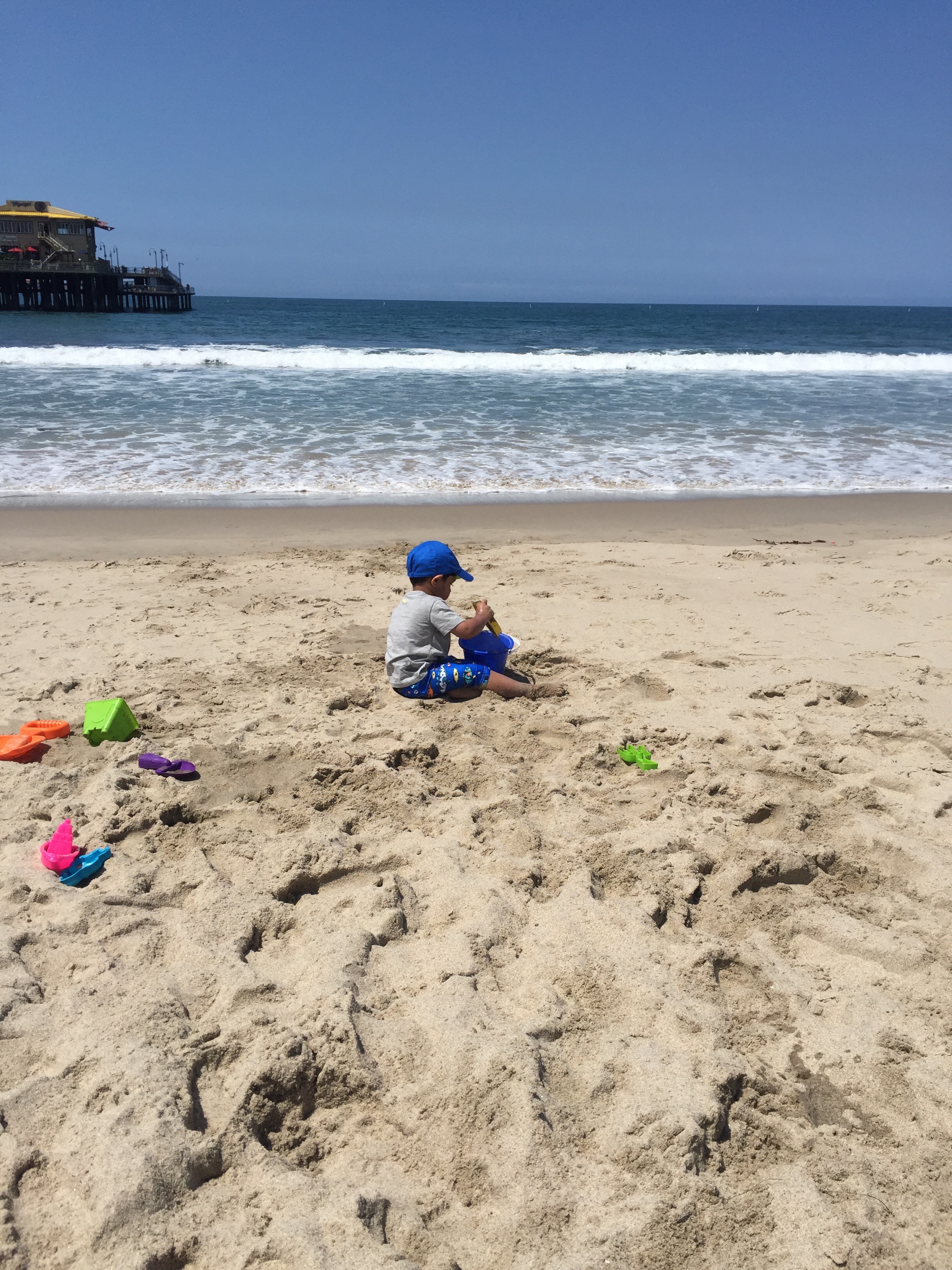
J at the beach

Just a few months ago, I was sitting in my 2-year-old son’s hospital room during his 4th of six hospitalizations to date. We were close to discharge, his asthma symptoms having abated again after an onslaught of medications, and I was desperate for J to sleep. He was exhausted, but the combination of unfamiliar surroundings, frequent interruptions, being hooked up to various medical equipment, and medications that make him restless and jumpy never resulted in much rest for him or us.

He finally fell asleep on my shoulder while I sat and rocked him in a hard, creaky wooden chair that had become all too familiar to us during our stays. J felt heavy and sprawling as I held him, and I had the thought that if these repeated hospitalizations continued, I didn’t know how much longer he would still fit in this chair with me. My arms, shoulders, and back ached from holding him up. He insisted on being covered with his thick green blanket while holding his favorite stuffed penguin, the combination of which soon began to make both of us sweat. He shifted and turned throughout the nap, as if he was attempting to mold my body into some kind of memory foam mattress for his comfort.

I stayed as still as possible because he needed this sleep. And I started to reflect on this whole nightmare, which had begun just before J’s 2nd birthday. This has by far been the most difficult experience of my life. Nothing has felt even close to as painful as watching my little boy struggle to breathe while we desperately tried everything at our disposal to alleviate his discomfort. Then we would get him stabilized in the hospital, take him home, and it would happen all over again. And again and again. My daily life was blanketed by fear. Hypervigilance over every little cough and breath, anxiety and worry about an exacerbation, all of which were almost paralyzing at times. J wasn’t always sick, but when he became symptomatic, things went downhill very, very quickly.

Sitting in J’s hospital room, I also thought about the other children we had seen on the pulmonary floor of this children’s hospital. Their rooms decorated, indicating how long these kids had been confined to such a sterile and colorless space. I felt both incredibly fortunate and horribly unlucky at the same time. While we don’t yet know what triggers J’s symptoms or why they take such a severe course, he does recover. We know we won’t be dealing with this frequency or severity of symptoms forever, but so many of the children on the pulmonary/CF floor will continue to be very ill lifelong.

I found myself thinking a lot that day in the hospital about how to be the best mother I can be for J. Many days, the worry is suffocating. All we can do is get through each minute, hour, day, with the threat of hospitalization looming over our heads. But life still happens during the intense worry, frustration, and fear. No one reminds me of that more than J himself. While I’m counting the days we have stayed out of the hospital, hopeful that we can string together another week or month, he is growing. I think what saddens me the most about everything we have been through the past few months is that all my worry and fear makes it difficult for me to truly enjoy this amazing time in his development that I know I can never experience again. He will only be an energetic and inquisitive 2-year-old once, learning new phrases and testing his capabilities and limits.

Against all odds, in between hospitalizations, we made it to California for a vacation and family member’s wedding. He wasn’t completely healthy when we were there, but J’s first trip to the beach was entirely magical for him. I, on the other hand, struggled to stay in the moment while I kept an ear out for the sound of his breathing against the crash of waves and children playing. I was aware of what I was trying to balance during that trip, and I resented both the circumstances and my own mind that prevented me from fully basking in the experience of my child playing in the ocean and sand for the first time. I hated that while J was so full of joy, I felt the heaviness of inner conflict and fear.

I worry about how the emotional trauma of all these hospitalizations and medical intrusions will affect J as he grows. At times I believe I haven’t done my job as a parent to protect him from repeatedly experiencing such distress, and I wonder if what he has gone through makes him feel unsafe or distrustful of the world and the people around him. I know he looks to us as his parents to help him understand what’s happening and what to expect. While this feels like immense pressure under stressful circumstances, it’s also an incredible opportunity and challenge for both J and me.

I have struggled at times with wondering if I should do a better job of pretending. Although I can keep a pretty straight face during sessions as a therapist, in my personal life, my emotions are written all over my face. Combine that with a child who is highly attuned, and I’m quite certain that even if I tried to hide my fear and anxiety from J, he wouldn’t buy it. And is that even what he needs? The longer we deal with this, the more I believe he needs a mother who feels and acknowledges her emotions – all of them. Because he feels them too. My job is not to teach him to be oblivious – I want him to be aware, to feel and notice all of it, and to acknowledge the unique mix of emotions he is experiencing in a given moment. I could use the reminder to do this more myself.

At home the other day, I watched J delight in dropping a plain piece of white paper in the air, watching it float and dance its way to the ground. I marveled at the thrill he felt in watching something so seemingly ordinary, while also listening to his breathing as he bounced and giggled around the room. Was I engaged enough? Did he sense that I was worried about his level of exertion? I ask myself these questions all the time. While I can’t pretend I’m not concerned, maybe my worry doesn’t have to take me away from him and these moments, spiraling wildly down a road of scary thoughts and worst-case scenarios. I nudge myself towards feeling and holding all these disparate emotions at once, juggling and balancing their various weights as I try to decipher what J and I both need. If this process sounds complicated, it’s because it often feels complicated to me, especially at this juncture in my life as J’s mother. But this time, almost without thinking, I suggested we drop two papers in the air at once. When his eyes lit up and he squealed with glee, I think he knew I was with him.

What It Really Means To Cook “Our” Food

I had this realization a few years ago: If I don’t learn my mom’s Indian recipes while she is still alive, they may be lost forever. When she moved to the U.S. in the 1970s, my mom had to adjust her cooking methods, ingredient use, and techniques to what was available to her at that time. In part because of these adaptations, I came to understand, no one makes Indian food exactly the way she does. So I slowly began the process of collecting recipes from her, focusing first on the ones that originated from her or were passed down from her mother. In my attempts to replicate her tried and true process, I pressed her for measurements of ingredients she has probably eyeballed for the past 30 years. But when I hear my mom talk about how hard it is to recreate the particular flavors of some of her mother’s specialties, I know that precise measurements are not enough and I am in the midst of a lifelong endeavor to prepare food that tastes exactly like what my mom would make.

As I continue to gather recipes from my mom, I notice that this process is as much about the sharing of memories about the role of food in family relationships as it is about documenting them on paper. Through my work as a psychologist, and as a mother myself, I am becoming more and more aware of how the process of cooking, feeding, and eating, as well as our relationships to food as a whole, are so complex and variable. In so many ways, eating is really more about our relationships to others and to ourselves than it is about the physical food itself.

This dynamic around food, relationships, and culture is apparent in our everyday lives, as well as in the media. We have all seen TV shows and movies portraying somewhat of a caricature of an immigrant mother. When the Italian grandmother or the Greek mother labors over a meal and (strongly) encourages her children to eat, she is doing more than just nurturing them with food. As I see it, part of this emphasis on feeding is related to the significance of holding onto and continuing to take in the culture of origin, via the food offered by the caregiver. For immigrant mothers like mine, reenacting a process of cooking and feeding that has been performed for generations in her family helped her feel more connected to her family in India. Just as importantly, serving her children the food she grew up eating reinforced the connection to our roots, in some ways bridging the gap between generations separated by thousands of miles.

In many ways, the challenge of raising children who understand and appreciate our heritage and cultural origins is greater for my generation than it was for my parents’. And this challenge will probably grow with each subsequent generation. Preparing food and feeding loved ones is such a significant part of Indian culture and family relationships, so I hope that my son will maintain an interest in trying the foods I grew up eating. I believe it’s one way in which he can feel closer to his family of origin and develop an ongoing appreciation of Indian culture as a whole. And maybe one day soon he will spend the day in the kitchen with me and my mom, observing, helping, learning, and forming memories of his own. In the meantime, I’ll keep adding to my recipe book and striving to prepare dishes that taste like what my mom makes, all the while reminding myself that it’s not really about the food.

How Can Parenting in the Present be Enhanced by Understanding our Past?

The two most interesting questions I get (outside of a professional setting) when people find out I’m a clinical psychologist:

  1. “Oh, so you’re reading my thoughts right now??”
  2. “So…do you think everything goes back to the mother?”

No matter how many times I have been asked that first question, I am still flabbergasted. My highly articulate response usually sounds something like, “Ummm….no,” while I wonder to myself if this person is actually thinking of psychics or X-men. The second question requires a more complicated response, and if I’m in the mood to go into it with random strangers at a party, their eyes typically glaze over, indicating they’ve lost interest before I have really begun to answer the question.

People often assume that in my work as a psychologist, I take on the position of “judging” the mother. My patients sometimes feel as though they are in the midst of some kind of clinical cliché if our treatment begins to center around their relationships with their mothers. I tell my patients that our work is not about judging or blaming the mother, but rather about understanding the relationship they had with their mother or other primary caregivers in order to better understand themselves. It’s hard to determine our direction in life if we don’t know where we came from, psychologically speaking.

This statement I make to my patients has never felt truer since I became a mother myself. There’s nothing quite like inhabiting this role to bring about empathy and that next level of understanding, both for my patients and for their mothers. And now, being in the position of both mother and psychologist, I am more curious than I ever could have been about the process of mothering, including the multitude of factors that impact how I was (and am) mothered and how this influences how I mother my own child.

One word I keep coming back to as I reflect on the kind of mother I strive to be is intentionality. Most parents will tell you that when you make parenting decisions, you often don’t know what you’re doing. You guess, hope, intuit, and consult your way through the process, all the while performing the monumental, and sometimes overwhelming, task of shaping a human being. While we may not always know what we are doing, we owe it to ourselves to try to understand why we are doing it. Why we make the choices we do, what and who has influenced us, in what ways each decision we make now is impacted by the thoughts, feelings, and actions of our caregivers and their caregivers before them. In other words, intentionality matters greatly, even as we stumble and feel our way through the journey of parenting.

As the children of immigrants, our parents moved to this country to provide themselves and their families with a better life and better opportunities. But immigration is a process fraught with various degrees of trauma and loss, including separation from loved ones, language barriers, and a significant shift in environment. Many of our mothers moved here shortly after marrying, which added on the task of attaching to a new partner while leaving the comfort of family and friends behind. They were simultaneously faced with adjusting to a completely new environment with new people, new responsibilities (inside and outside the home), and, for many of them, navigating their way through the process of continuing their education, training, or employment in a new country/system.

And then they had children. I sometimes find it difficult to wrap my head around the complexities of giving birth to and raising children in a foreign land, oftentimes early in a marital relationship and without the consistent presence and support of their own mothers. In so many ways, we learn how to mother through the experience of being mothered ourselves, and in our parents’ culture of origin, raising a child is a process often contributed to by grandparents, siblings, and community. The impact of mothering in relative isolation, halfway across the world, has far-reaching implications. To be clear, I am not unequivocally stating that we were at a disadvantage as a result of being born and raised so far away from our extended families. The extent to which each of us was impacted by this geographical distance, and how these dynamics played out within our own families, varies greatly.

Regardless of the specific factors at play, our parents took great risks and suffered tremendous losses with the hope of providing us with safety, security, and opportunity. Our parents’ intentions were to offer us something in this new country that they may not have been certain we would receive in their home countries. But in unfamiliar territory and under a new set of rules, their intentions had to be centered around providing their families with the necessities. Particularly during our early childhood, our mothers focused on our safety, security, and physical health by making sure we were well fed, clothed, and comfortable. They emphasized education and participation in extracurricular activities, preparing us for higher education and successful professional lives.

We have similar intentions in mind as we raise our children, but these objectives of providing physical safety, security, and opportunity are generally not as difficult for us to achieve as they were for our parents. Our parents paved a path for us that has made our lives more comfortable in many ways.

This is why it is not enough to simply reiterate our parents’ intentions as we raise young children ourselves. Our parents have given us the opportunity to strive for more, especially in the way that we raise the next generation. We now have the luxury of reflecting on the way we, and perhaps even our parents, were raised in order to attend to our children on a level that our parents often could not.

We can, should, and need to think deeply and thoroughly about so many things – how we approach feeding our children, what messages we are sending about body image and sexuality, how we navigate gender roles, to what extent and why we involve religion and spirituality in our family life, how we navigate various developmental phases, and so much more. We have the opportunity to understand our mothers’ experiences, for instance, in order to better explore ourselves, thereby promoting our growth towards the next level of parenting and living. The way I see it, this is one of the most important gifts our parents’ immigration has given us.